


The "Main" Road: Route 66
Index to this page
- Context: "The Grapes of Wrath"
- The famous "Mother Road" quote
- The Term "mother road"
- Mother Road as used by Steinbeck

Context: "The Grapes of Wrath"
John Steinbeck's book
American novelist John Steinbeck (1902-1968) was the man who named Route 66 "the Mother Road" in his Pulitzer Prize-winning novel "The Grapes of Wrath", published in April 1939.
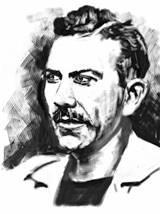
John Steinbeck by Kiran Guckian
The Grapes of Wrath was an instant success, and a movie directed by John Ford was shot in 1940, actor Henry Fonda portrayed Tom Joad.
The Story of the Joads
In his book, Steinbeck tells the story of a family, the Joads, during the tragic days of economic and climatic turmoil during the 1930s.
The novel begins with Tom Joad being released from prison, where he was serving a jail term for homicide. Tom goes back to his family's farm in Oklahoma, accompanied by Jim Casy, a roaming preacher.
They find the farm deserted and learn that the family has been evicted by the bank and had to seek refuge at the farm of Uncle John Joad.
Farmers defaulted on their loans due to the Dust Bowl, which ruined their crops, and their farms were repossessed by the Banks. The farmers lost everything. The Joads must move on and find work, or starve.
The Dust Bowl

Dense black dust clouds, Texas Panhandle, March 1936
Arthur Rothstein
A severe drought struck the Midwest in the 1930s. The poor farming techniques, lack of vegetation to retain the dry topsoil, and strong winds provoked vast dust storms known as "black blizzards". The ominous black dust clouds blanketed the prairies of Canada and the United States. Dust settled as far away as New York City.
Over 100 million acres of once verdant farmland were ruined (400,000 km2). Farmers lost their crops and cattle. Facing famine, and unable to payback their bank loans, they defaulted on their mortgages.
An estimated 210,000 people took to the road and headed west, seeking jobs in California. However, the Great Depression that began with the "Black Tuesday" stock market crash in October 1929, had shattered the economy, investors had lost fortunes, banks collapsed, industrial output fell, and unemployment skyrocketed.
The lack of jobs forced many to return home; barely 8% of these forced migrants remained in California.
The Joads, accompanied by Tom and Casy, pack their scant belongings into the family's car, which they converted to a truck, and head west to California, where they think they will be able to find jobs.

The travelers head towards the main road that runs from Oklahoma to California, Route 66, and here is where John Steinbeck dubbed Route 66 as the "Mother Road".
The famous "Mother Road" quote
In Chapter 12 of "The Grapes of Wrath", Steinbeck coined the name for Route 66 (highlighted below):
Highway 66 is the main migrant road. 66—the long concrete path across the country, waving gently up and down on the map, from the Mississippi to Bakersfield—over the red lands and the gray lands, twisting up into the mountains, crossing the Divide and down into the bright and terrible desert, and across the desert to the mountains again, and into the rich California valleys.
66 is the path of a people in flight, refugees from dust and shrinking land, from the thunder of tractors and shrinking ownership, from the desert’s slow northward invasion, from the twisting winds that howl up out of Texas, from the floods that bring no richness to the land and steal what little richness is there. From all of these the people are in flight, and they come into 66 from the tributary side roads, from the wagon tracks and the rutted country roads. 66 is the mother road, the road of flight. John Steinbeck "The Grapes of Wrath"

Chapter 12 tells the terror of the journey, thousands of cars, wrecks along the highway, lack of money, food, no spares, old jalopies, threadbare tires, strained engines, thirst, despair and valour. Steinbeck ends the chapter "...how can such courage be, and such faith in their own species? Very few things would teach such faith.The people in flight from the terror behind—strange things happen to them, some bitterly cruel and some so beautiful that the faith is refired forever."
The Joads' Journey
The Joads' trip along Route 66 is an ordeal. They meet other migrants fleeing west and many returning without finding jobs in California. Granpa Joad dies on the way, and so does Granma. The group splits up when the eldest son, Noah, and the husband of the pregnant Joad daughter (Rose of Sharon) depart. Ma Joad leads them onwards, as there is nothing to go back to in Oklahoma.
Below are two stills from the 1940 Academy Award-winning movie based on Steinbeck's book.
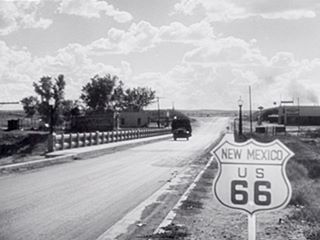
Joads crossing the Pecos River, Santa Rosa, NM, US 66.
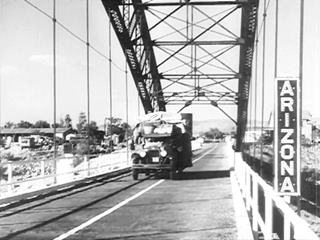
Joads on US 66 at the Colorado River Bridge, AZ-CA
They finally reach California, but their prospects are grim, jobs are scarce, and wages are low; the migrants are exploited by the large farming concerns. The exiles find refuge in a camp run by the Federal Resettlement Administration, which offers some protection to the needy.
Casy tries to organize a labor union to resist exploitation. A strike in a peach orchard turns sour, and Casy is beaten to death. Tom Joad kills the attacker and flees. The family moves to a cotton farm, where Tom moves on, and Rose of Sharon's child is stillborn. Ma Joad stands strong, and as they seek shelter from a flood, they find a young boy with his father, who is dying from starvation, and Rose of Sharon saves him by offering him her breast, a symbolic scene showing how human care and love prevail over the hardships of life.
>> Learn more: The Grapes of Wrath
The Term "mother road"
The English term "mother road" does not have a maternal connotation; instead, it means the main one, the principal, chief among many. It was applied to railroads in the 19th century, as you can see in This U.S. Senate hearing from 1887, and in the railroad publication shown below, from 1874.

The term as used for highways, in the late 1800s meant "...the first, oldest among many, original, chief among many, main, principal... as a road, the main road, or the mother road."
Mother Road as used by Steinbeck
Steinbeck used the term to define U.S. Highway 66 as the road of flight, a way to escape the deadly fate of drought, hunger, and joblessness. It also embodies courage and faith. In Chapter 17, Steinbeck describes the journey along the "great cross-country highway":
The cars of the migrant people crawled out of the side roads onto the great cross-country highway, and they took the migrant way to the West. In the daylight they scuttled like bugs to the westward; and as the dark caught them, they clustered like bugs near to shelter and to water. And because they were lonely and perplexed, because they had all come from a place of sadness and worry and defeat, and because they were all going to a new mysterious place, they huddled together; they talked together; they shared their lives, their food, and the things they hoped for in the new country...
Sponsored Content
>> Book your Hotel in Kingman AZ


Credits
Banner image: Hackberry General Store, Hackberry, Arizona by Perla Eichenblat
Social Media


