

The reasons that led to Route 66's decertification
Index to this page
The Reasons behind Route 66 being Decommissioned
Route 66 was created in 1926, when the U.S. Highway System was implemented. It created the first interstate highway system in the U.S., the Fedral government provided funding which were combined with local and state funding to build and maintain the network.
The states were responsible proposing alignments, which were approved by the American Association of State Highway and Transportation (or AASHTO), construction, and maintenance of the system.
Aging, Obsolete, and Costly Highway
World War II had shown that the highways could not carry the heavy-duty military traffic that was crisscrossing the nation. Even though the government invested in upgrading the numbered U.S. highways (like the straighter and shorter four-lane alignment built on Route 66 in Hooker, Missour), the system needed a radical reform.
During World War II, General Dwight Eisenhower had seen how useful the German autobahn freeway system had been for the war effort. He was also aware of how outdated the U.S. Highway network had become. When he was elected the 34th President of the United States in 1953, he had the chance to implement is vision of modern highways linking America.
The 1956 Interstate Highway Act
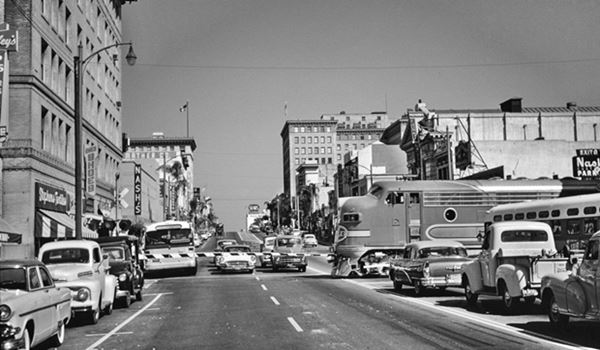
Eisenhower signed the Federal-Aid Highway Act of 1956, on June 29, 1956. It authorized spending $25 billion (equivalent to $300 billion today), over 13 years, to build a modern high-speed, limited access, multi-lane superhighway system, 41,000 miles long (65.600 km). It would be financed by a fuel tax.
The interstate highway standards were more stingent than the ones used on previous divided highways. The system aimed at safety by reducing accidents, and avoiding congestion by eliminating bottlenecks.
Route 66 and the Interstate System
Route 66 had been upgraded during the late 1940s, and early 1950s in Illinois, Missouri, New Mexico, Oklahoma, and California. The states had improved the highway by building a second set of lanes, parallel to the original alignment, turning it into a four-lane highway. But as we mentioned above, they were not up to Interstate standards and had grade crossings, narrow shoulders, and curves. These alignments were replaced by the Interstate System. Below is a section of Route 66 close to Pontiac, Illinois, the state has abandoned two of the lanes, and opted to maintain a two-lane roadway.

The new alignment avoided the congested down-town city areas, had wider, safer curves and a straighter course. This interactive map shows Route 66's alignments in Odell, Illinois, the final 1950s four-lane divided highway around the town is marked with a green line. Notice how I-55 now curves further from the city, and includes an interchange (Exit 209). The old highway had grade crossings. North and south of Odell, the freeway follwed a completely new alignment that runs west of the old 4-lane U.S. Hwy. 66 (violet and orange lines).
Before the Interstate system, the state of Oklahoma had built a tollway, known as the Turner Turnpike. It opened in May 1953, and linked Tulsa with Oklahoma City, avoiding the congested Route 66. Four years later, in 1957, the Will Rogers Turnpike opened, linking Tulsa with the Missouri State Line.
Overlapping and Redundant Alignments after 1956
After 1956, the interstate system grew at an astonishing speed, and many of them were built very close to Route 66, following its alignment closely.
Other U.S. Highways, like U.S. 20 or U.S. 50, ran quite far from the Interstates, sometimes parallel to them, but often more than 50 miles from them. They were necessary, and they survived.
1956 photo of the new four-lane Route 66 "superhighway" (left) in Phillipsburg, (now I-44) seen from the old Route 66 (right). Looking west.

US 66, on the other hand, ran close to (sometimes right beside, as you can see in the picture above) the newer and safer Interstate highways. It became redundant, and had to go.
- In Illinois, I-55 runs from Chicago to East St. Louis, on the Mississippi River.
- I-44 overlaps Route 66 from St. Louis, Missouri, all the way to Oklahoma City, OK.
- I-40 continues west, from Oklahoma City, crossing the state of Oklahoma, Texas, New Mexico, Arizona, and California, ending in Barstow, CA.
- I-15 replaced US 66 from Barstow to San Bernardino CA. And from there, the freeways crossed Los Angeles, like I-10, I-215, I-210, and State Hwy. 110, the Historic Arroyo Seco Parkway segment used by Route 66 from 1940 to 1964.
As the Federal funds were focused on building and maintaining the Interstate system, the parallel routes, now known as "legacy" or "secondary" highways, like Route 66, were seen as a costly burden, requiring state funds for upkeep. This led the states to request that the AASHTO delist certain U.S. highways in their states, allowing the states to decide their ultimate fate and upkeep requirements.
Decommissioned in California
The California Highway Commission requested on Aug. 26, 1963, the "Elimination of Route 66... Between Jct. U.S. 95 Needles and Santa Monica" it was approved by the AASHO on Nov. 14, 1963. I-40 and I-15 replaced the former alignment between Needles and Santa Monica.
Route 66 is Decertified in Missouri and Illinois in 1974
After the completion of I-44 across Missouri, on June 24, 1974, the American Association of State Highway and Transportation (or AASHTO) approved the motion to relocate the eastern terminus of Route 66. It was moved from Chicago, Illinois, to a spot in western Missouri, close to Joplin. This decommissioned Route 66 in Illinois and Missouri.
This new eastern terminus was located at I-44's exit 15 east of Joplin, in the town of Scotland, MO (see it in this interactive map).
Decommissioned in Arizona - 1979
The next step towards the elimination of Route 66 was the elimination in western and central Arizona. The AASHTO approved this decommissioning on June 29, 1979. The western terminus of Route 66 moved from Needles, California to the small village of Sanders, Arizona, at the junction of U.S. 66 and U.S. 191 (see our custom map).
U.S. 66 decertified in California and most of Arizona in 1979

The Western Terminus of Route 66 remained there in Sanders until the whole highway was finally decommissioned in 1985.
Finally Decommissioned in 1985
Elimination of U.S. Route 66 - APPROVED - Eliminate present U.S. Route 66 between the present beginning at Scotland, Missouri and the terminus at Sanders, Arizona. AASHTO (1985)
Route 66 was decommissioned and eliminated on June 27, 1985 when it decertified the remaining stretch, that crossed Western Missouri (Scotland to Galena), Kansas, Oklahoma, Texas, New Mexico, and Arizona (Lupton to Sanders).
Route 66 had officially disappeared.
Dangerous Highway 66
The Dangers of Route 66

Route 66 was known as "Bloody 66" and had its fair share of deadly right-angle curves ("Dead Man" Curves). Accidents were frequent, and deadly due to the unsafe vehicle designs of the 1940s to 1970s period.
The leading causes of accidents were the following;
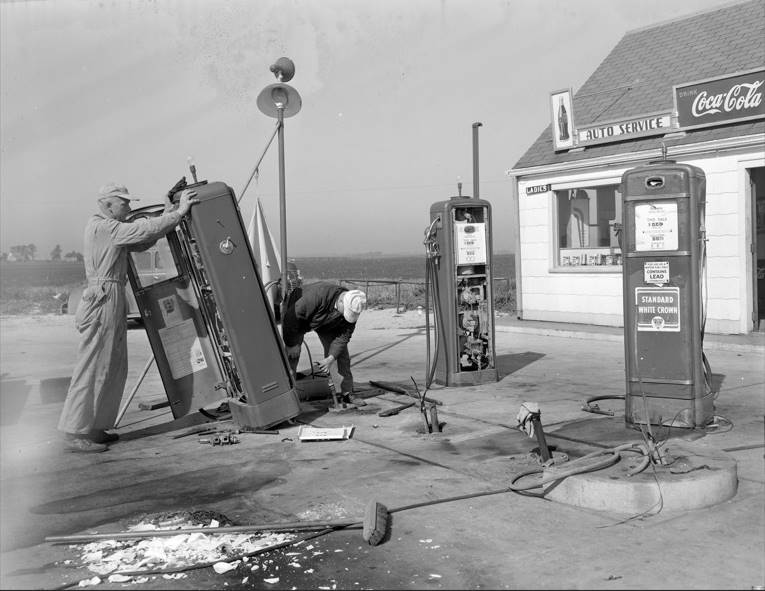
Hit and Run 1948, Henderson's Standard Service. Towanda, ILSource.
Click image to enlarge
- Obsolete Roadbuilding Technology. The original 1920s and 1930s alignments had narrow roadways, two-lane stretches of highway, rough and ungraded shoulders, sharp curves, buildings, signs, and obstacles close to the roadway, narrow bridges, winding alignments, congested intersections in its urban segments along main streets that crossed the downtown areas of large cities (like Tulsa, Springfield, Oklahoma City, or Amarillo). Grade railroad crossings and country road intersections.
Later 1940s and 50s four-lane highways had narrow medians (some with curbs), they lacked guard rails, and had grade crossings. - Heavy Traffic. The trucks were slow, and the roadway was narrow. After World War II, traffic boomed, people travelled more, there were buses and tourists driving across the continent. Congestion was common.
- Speeding. During the 1940s, as roadways improved and car design allowed higher speeds, drivers tended to speed. This caused many accidents.
The image above shows two men repairing the pumps at Henderson Service station in Towanda, Illinois. They had been "damaged by hit and run truck," picture taken on May 19, 1948. Dangerous days on Route 66!
Historic Route 66 100 years old in 2026
But the highway lived on, as state highways, designated with the number "66". Route 66 Associations, local businesses, and town councils set out to recover the road, and preserve its heritage. Several sections along former Route 66 have been designated and signed as "Historic Route 66".
Even though Route 66 hasn't existed since 1985, this year, 2026 it celebrates its 100th Anniversary!
>> Learn all about Route 66 Centennial Celebrations 1926-2026
Sponsored Content
>> Book your Hotel in Kingman AZ


Credits
Banner image: Hackberry General Store, Hackberry, Arizona by Perla Eichenblat
Social Media


