

Imperial 400 Motels along US66
Index to this page
Imperial '400' Inc.
Company History
A Franchise Motel Chain
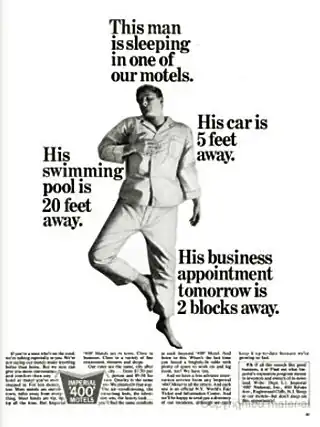
Imperial 400 motels advertisement in Life, May 1964. Source.
The company was established in Los Angeles as a California Corporation in 1959, by Benard Whitney in partnership with Leslie N. Aikman.
They opened their first 34-room motel in Hollywood in July 1960. It would be the only one run by the company, the others were operated by the franchisees.
In 1962, it moved its headquarters to the East Coast, to Englewood Cliffs, NJ. It made a public share offering in 1963, in which it described its business model as follows: "The company is engaged in the business of developing and operating, on a co-ownership basis, a chain of motels under the name "Imperial '400' Motels." After the company has completed a motel so that it is ready for guest occupancy, the company generally enters into a partnership with a co-owner who has purchased from the company up to a 50% interest in the motel and who will reside at the motel and conduct its day-to-day operation under the company's supervision. A few motels in the chain are wholly-owned by the company and are operated by it directly or by others under a combined lease-license arrangement. By September 30, 1963 a total of 68 motels had been opened, principally in the western half of the country, an additional 19 motels were in various stages of construction, 8 additional sites for motels had been acquired upon which construction was expected to commence in the near future and 16 additional sites were under contract to lease or purchase." (Source).

By 1964, it was the country's fourth-largest motel chain. The advertisement it published in Life magazine in May 1964 (see picture) and boasted that "we'll be happy to send you a directory of our locations, although we can't keep it up-to-date because we're growing so fast." It also included a pitch for potential franchisees. At that time its offices were located at 460 Sylvan Ave., Englewood Cliffs, New Jersey... "Sleep at our motels — but don't sleep on this opportunity!"
Its strengths were that all of the motels were located in strategic downtown areas, it offered standard rates coast-to-coast, and it allowed free advance reservations. The rooms offered more luxury than comparable motels.
The chain spanned the nation, with motels in many places, like Valdosta, Georgia, Sioux City, Iowa, Bay City, Michigan, Austin, Texas, Twin Falls, Idaho, O'Hare, Chicago, Illinois, as well as New York, Pennsylvania, Indiana, Colorado, Utah, Oregon, Minnesota, N. Carolina, Connecticut, and even in Regina, Saskatchewan, Canada. By mid-1965, it had 116 motels in 38 states, with 5,000 rentable rooms.
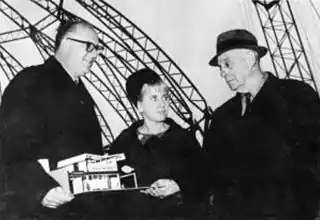
Motel in the 1964-65 New York World Fair. Source.
In 1964, it took part in the New York World Fair. The image shows a model of the full-sized motel that was erected at the Fair. Robert Moses (left) was the Fair President, to the right is Bernard Whitney, president of Imperial, and his wife (center).
The full-size building was built inside the Transportation & Travel Pavilion as Whitney believed that "through this exhibit, millions of visitors will become familiar with our motels and will be briefed on our locations, referral system, accommodations, rates and hospitality."
The Name
During the New York World Fair, Whitney explained the origin of the chain's name: "it was suggested by the familiar reference to "the 400" of New York City's Social Register. "But it has come to mean more than that," he says. "Today, the 400 represents the number of motels we have set as our goal."
So, the company used the words Imperial and "400" to suggest luxury, high society, and belonging to the upper class, yet it marketed itself as a "thrifty" option as we will see below.
The "400"
The name comes from a list of the "Who's who", the upper crust of New York's upper class during the Gilded Age (a period of materialistic excesses, monopolies, and political corruption that made some rich people vastly wealthy). It was defined by Caroline Schermerhorn Astor through her friend, Ward McAllister and published on February 16, 1892, by the New York Times.
Marketing
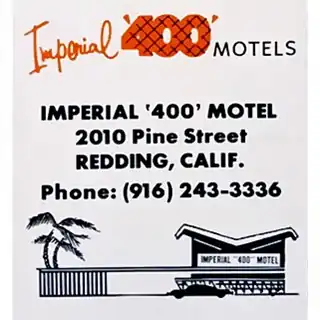
Imperial "400" matchcover.
The motel based its marketing pitch on offering the same rates in all of its locations. The advertisement published in the May 1964 Life magazine shown further up summarized their benefits: "If you're a man who's on the road, we're talking especially to you. We're not saying our motels make traveling better than home. But we sure can give you more convenience and comfort than any hotel or motel you've ever stopped at. For less money, too. Most motels are out-of-town, miles away from everything. Most hotels are tip, tip, tip all the time. But Imperial '400' Motels are in town. Close to business. Close to a variety of fine restaurants, theaters, and shops. Our rates are the same, city after city... from $7.50 per person and $9.50 for two. Quality is the same, too. We planned it that way. The air-conditioning, the extra-long beds, the television sets, the luxury look... you'll find the same comforts at each Imperial '400 Motel."
The Floating Butterfly Roof
The distinctive roof was designed by Palmer and Krisel, and as you can see in the image above, it was almost a trademark, as it appeared on their advertising.
Composite image: 1960s and current view Flagstaff, Arizona motel. Click image for Street view
The Architects
William Krisel (1924-2017) was born in Shanghai, China, to a diplomat father. The family relocated to California when Japan invaded China in 1937. He enlisted in the Army during World War II as a fluent Chinese-speaking translator. After the war, he studied architecture and in 1950 partnered with Dan Saxon Palmer.
Daniel Saxon Wiesinger Palmer (1920-2006) was born in Budapest, Hungary. He changed his last name to Palmer in 1942. During WWII, he served in the Army Corps of Engineers.
During the construction boom in California, Palmer and Krisel (P&K) designed homes for the parents of the Baby Boomer generation, and by 1960, they worked with most of the largest home builders in America, and had 60 employees.
The Design
The striking feature of the Imperial 400 motels was the roof over the main building, reception, and office, which was the creation of Palmer and Krisel (P&K), two leading architects from Los Angeles.
Examples of Krisel's initial work with this kind of roof can be seen at the Twin Palms Estates in Palm Springs, California, a development of Alexander Construction Co. Its homes featured the famous and distinctive "roof with two wings". It was built in 1957, and it offered the homeowners a choice of roof design (Butterfly, flat, sloped, or gabled). Below are two views of Twin Palms, when it was built, and nowadays (Source).
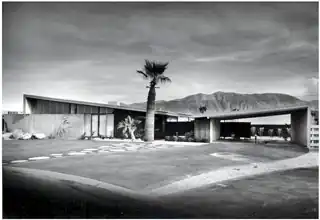
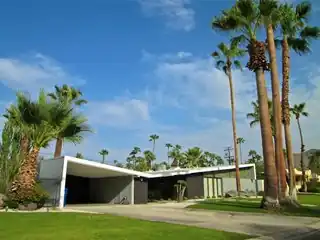
The studio used this same butterfly wing design concept for the Imperial "400" motels.
The roof offered several advantages. It made use of the folded-plate design, where slabs of concrete are linked together at their edges. Folded plates are self-supporting, rigid, and can span large areas without the need for columns. They use less concrete and steel than regular beam-and-slab roofs, which makes them cheaper.
They allow for higher walls along the perimeter, where clerestory windows can be used (these windows, whose name comes from "clear storey" are located above eye level, and they allow light, and fresh air to enter, but preserve the privacy.
The First Motel
P&K not only designed the concept of the butterfly roof for the motel, but they also obtained the building permit and oversaw the building of the first motel of the chain. It cost $240,000, and was the only one in the chain that was owned by the company, and it served as a training academy for the franchise partners. Here, they learned how to manage a motel and take care of the guests.

Among the first motels built were the ones located in Phoenix, AZ, San Diego, CA, and another one on Olympic Blvd., Los Angeles.
The Rooms
The motel chain's postcards stated the amenities of their hotels: "Color Television in all rooms - Heated Swimming Pool - Free Coffee - Refrigerated - Electric Heat - AAA. Diner's Club, Carte Blanche, American Express, Mobil Oil, Master Charge and Bank Americard"
They did not have cafes or restaurants on the premises; instead, they were located in convenient locations close to restaurants and cafes.
The image below shows the interior of one of the rooms of the flagship motel on Sunset Boulevard in Los Angeles.
The Flagship Motel in Hollywood
It was built a few blocks from Route 66 (which ran along Santa Monica Blvd.) and was located at 6926 Sunset Blvd. in Hollywood, Los Angeles, California. It opened in July 1960. The building is still there, and it is a motel (Hotel Hwood). Below is a "Now and Then" set of pictures:
Demise and Rebirth
"America's Fastest Growing Motel Chain"
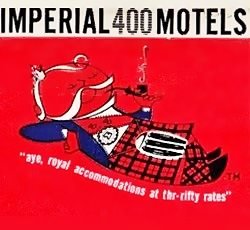
Imperial "400" Motel ad. Source.
Its postcards boasted that it was the fastest growing motel chain in the nation, opening one new motel every 10 days. Its quick growth strained its resources and led to financial woes.
Its equity was originally $60,000, yet its expenses were millions of dollars. When it went public, it obtained capital, but it was not enough. The company didn't own the properties; it leased them for terms ranging from 54 to 65 years. These leases would become a heavy burden for the company. The co-owners were mostly husband-wife partners who ran the motels and also shared profits and losses. They had to provide capital and also cope with the mortgage payments. The motels themselves were not profitable, for instance, in 1965, with almost $9.5 Million in gross revenue, the company had a loss of $434,000 from its motel operations.
It had kept on going by recruiting new co-owners but when these became harder to find in 1963, and lacking financial backing to carry the losses that motels normally have during their first years (until they establish their reputation), these became such a burden that on June 3, 1965, Imperial '400' National Inc, a Delaware Corp., Imperial '400' Corporation, a Nevada Corp., Imperial '400' Land Corporation, a Delaware Corp., filed a Chapter XI bankruptcy petition in the U.S. District Court of New Jersey. They were unable to pay their debts as they matured.
During its administration by a court-appointed trustee, the company made a profit in 1967 and continued doing so, reaching a profit of $927,000 on an income of $12 Million in 1971. (Source).
A Luxembourg-based company, Interpart S.A., acquired the chain in 1986 for $27.5 Million and dissolved it one year later. (Source). Interpart also owned the Melia Hotel chain, but eventually the dealings of its owner, Giancarlo Parretti, ended in bankruptcy too.
Many of the motels are still in operation, under different names, below we mention the ones that stand (or stood) along Route 66.

The Route 66 Imperial '400' Motels
Imperial 400 Motels Along Route 66
The chain had five motels on U.S. Highway 66, and the buildings are still standing. They are the following. More details further down.
- Imperial 400 in Albuquerque, NM
- Imperial 400 in Winslow, AZ
- Imperial 400 in Kingman, AZ ❌
- Imperial 400 in Flagstaff, AZ
- Imperial 400 in Barstow, CA
- Imperial 400 in San Bernardino, CA ❌
- Imperial 400 in Pasadena, CA
- Imperial 400 in Los Angeles, CA
A state-by-state list of each motel.
New Mexico
Albuquerque, NM: Imperial 400 Motel
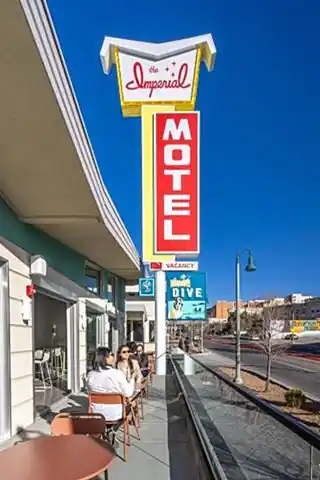
Imperial Inn remodeled in ABQ.
On the corner, at 701 Central Ave NE, was the 1960s Imperial 400 Motel that, until recently was still operating as the Imperial Inn in the original building that was slowly decaying.
However, in 2021, the city of Albuquerque began a redevelopment project that cost around $7.6 Million to restore and preserve this building.
The project covered 52 guest rooms and 16 residential suites, along with space for a dozen new businesses, including retail and restaurants.
The original neon sign was restored and can be seen in the image (St. view).
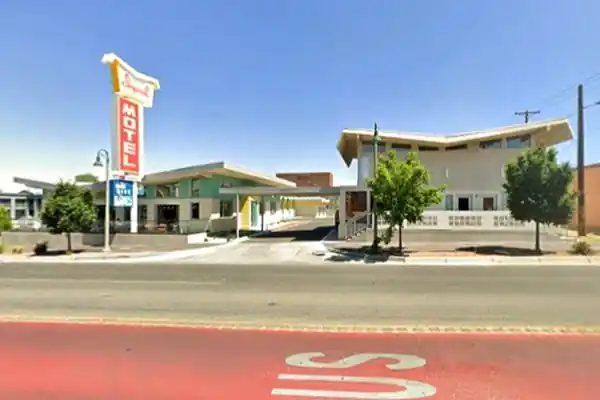
Imperial Inn nowadays. Click image to enlarge.
The new wing to the west replicates the butterfly wing roof in a homage to its distinctive design.
In its golden days, this classic motel announced on its Albuquerque postcard, that it was "A pleasant place to stay for rest, relaxation, or to make a headquarters for your business trip into the heart of the city."
>> You can Book a Room in The Imperial Inn.
Imperial 400 Motel in a vintage 1960s postcard
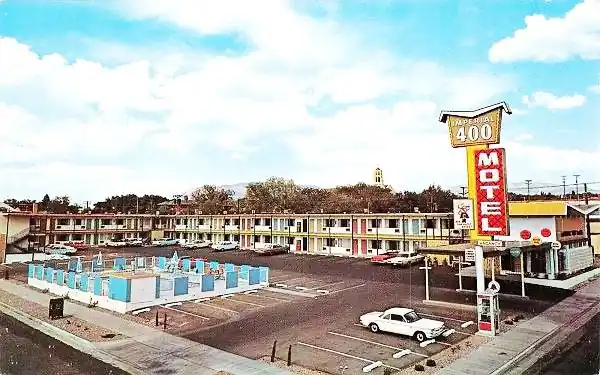
A view of it before its redevelopment project began; it had maintained its original appearance and its original neon sign with for 60 years!
Arizona
Winslow, AZ: Imperial 400 Motel
The motel is located at 1224 2nd Street. It spans the block between 2nd and 3rd streets. It is the former "Imperial 400 Motel", which is now the "College View Apartments". The original swimming pool has also been removed. Below is a "Now and Then" set of pictures, click to enlarge the postcard.
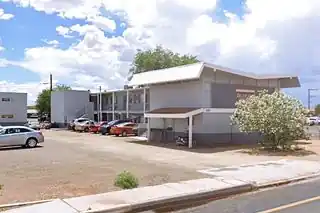
The Imperial 400 motel nowadays. Click for St. View
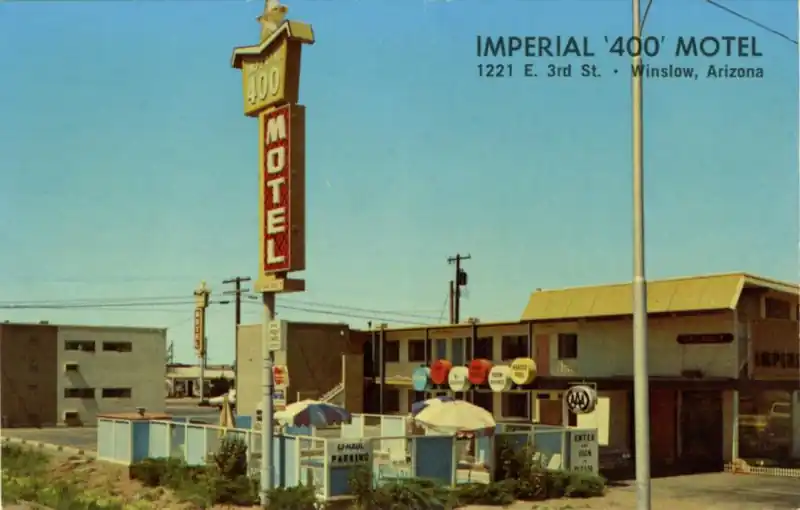
1960s Postcard of the Imperial 400 Motel. Click the image to enlarge it.
Source
Flagstaff, AZ: Imperial 400 motel
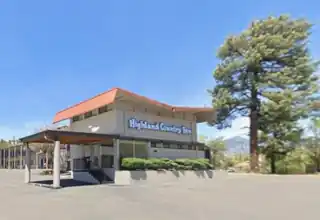
Flagstaff motel now. Click for St. View
This building has survived, and it is still operating as a motel, now under the "Highland Country Inn" brand.
It is located at 223 South Sitgreaves (Route 66). Below is a 1960s postcard of this motel, and the thumbnail shows its current appearance with its classic roofline.
>> You can Book a Room in This Motel.
Kingman, AZ: Imperial 400 motel ❌
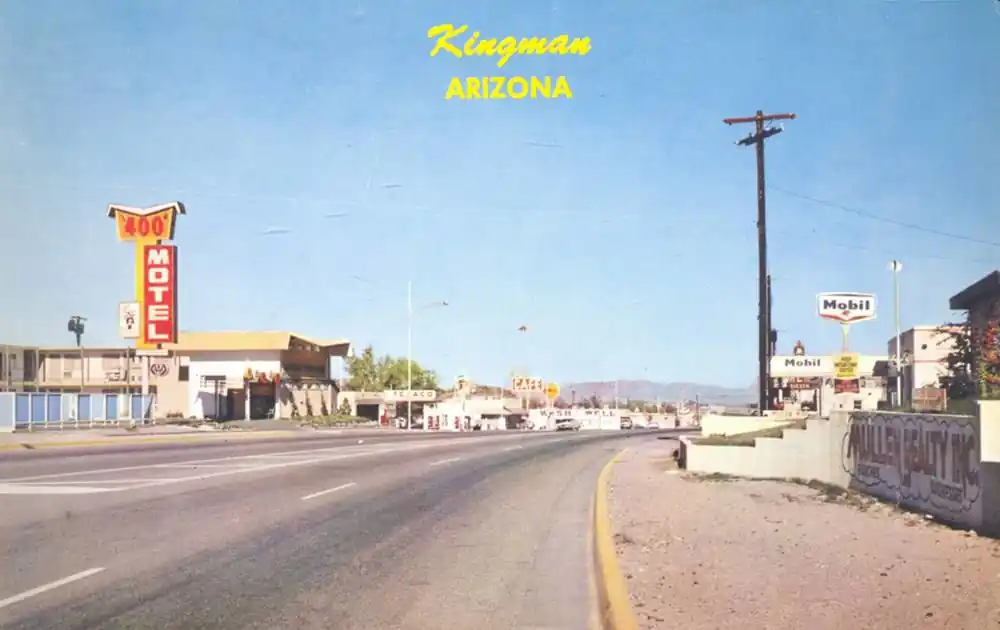
The motel, now Gone, was located at 1911 Andy Devine.
It can be seen in the postcard below, and, to the left, in the thumbnail image, is the view looking north along Andy Devine Ave., opposite the Mobile station that is marked with a red arrow (click on the image to enlarge it).
This is a street view of the spot, where a Walgreens now stands.
Below is a 1960s postcard of the motel.
California
Needles, CA: Imperial "400" Motel
Now closed for good, on the corner at 644 West Broadway St. It replaced the Russel brothers' Texaco that had stood on the corner since the 1930s.
It is a two-story complex with stucco plastering, with an L-shaped layout.
The motel's postcard, shown below described it as follows: "IMPERIAL 400 MOTEL On Highway 66, Downtown... 644 Broadway Needles, California Air Conditioning ... T.V.... Room Phones Kitchenettes... Heated Pool... Free Coffee Free Advance Reservations Major Credit Cards Accepted..."
Needles Imperial 400 in a 1960s postcard
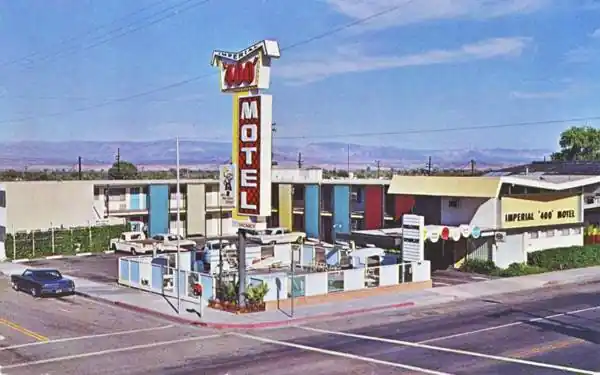
Closed since the 2020 pandemic, it retains its original structure but without the red and blue colored bands on the building.
Barstow CA: Imperial 400 Motel
At 1281 E Main St., is the former Imperial 400 (now the Best Motel).
>> You can Book a Room in the Best Motel.
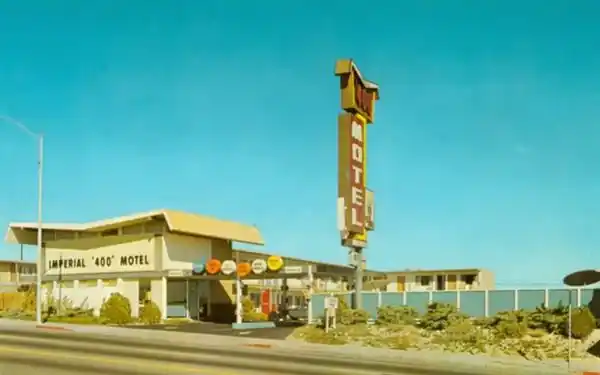
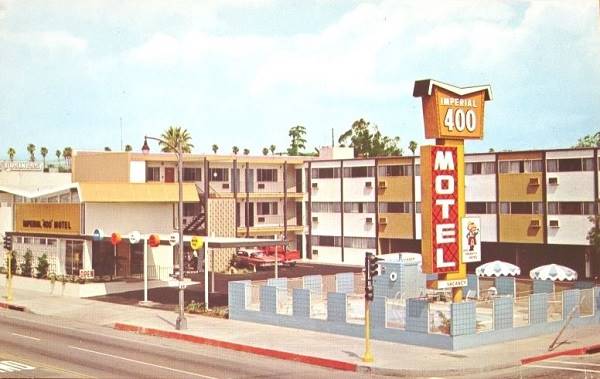
The "Then and Now" set of images shows that the canopy over the entrance has been removed with its 60's colored oval signs, and the main sign has been toned down from a classic Route 66 sign to a more sedate contemporary design.
Imperial 400 Motel nowadays, it is a "Best Motel"
San Bernardino, CA: Imperial 400 motel ❌
The motel, now Gone, was located at 755 W 5th St.
Its can be seen in the postcard below. See its Street View in 2007, one year before it was razed.
Pasadena, CA: Imperial 400 Motel
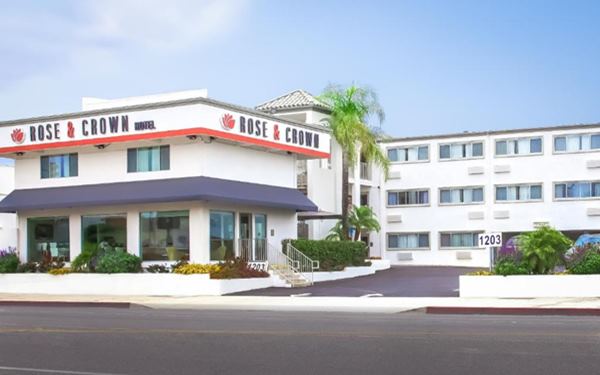
Located on the corner with N Michigan Ave at 1203 E. Colorado Blvd. This motel unlike the others in the motel chain had three-stories instead of two. Now it is the Rose & Crown Hotel.
>> You can Book a Room in The Rose & Crown.
End of this Imperial '400' Motel's Itinerary
This marks the end of our journey along Route 66, visiting its Imperial 400 Motels. Enjoy your Road Trip!

Sponsored Content
>> Book your Hotel in Kingman AZ


Credits
Banner image: Hackberry General Store, Hackberry, Arizona by Perla Eichenblat
Social Media


