

Teague Texacos along US66
Index to this page
Mini Bio of Walter Dorwin Teague (1883-1960)
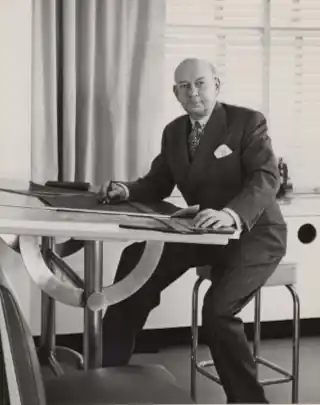
Walter Dorwin Teague
Teague was an American industrial designer, a pioneer in the field, who helped establish it as a profession. He studied at the Art Students League of New York and worked in an advertising agency. He later freelanced as an advertising designer, where the requests from his customers oriented his career towards product design. He was well knwon for product design, exhibits, interiors, and corporate graphics. Teague designed two cameras for Kodak in 1927, exhibits for the New York World Fair of 1939-40, the interior of the Boeing 707 passenger jet aircraft, and the Texaco service stations.
He used his marketing and design savvy when he set out to create the trademark Texaco service stations.
Texaco
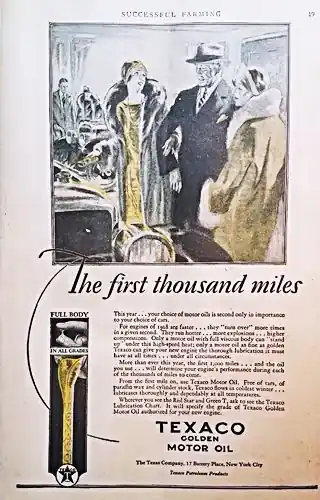
Texaco Golden Motor Oil 1920s ad.
Texas Fuel was established in March 1901 in Beaumont, Texas. The partners included an oilman, Joseph S. Cullinan and out-of-state investors. Its purpose was to buy and ship oil from the Spindletop oilfield in Beaumont. The following year, it incorporated in Sour Lake as the Texas Fuel Company1
It grew fast, buying barges and rail tanker wagons, expanding to new fields. In 1905, it built its first pipelines to Port Arthur on the Gulf of Mexico, where it built its first refinery. It expanded overseas between 1905 and 1913. After WW I, it patented a new oil refining process, improving productivity. In 1928, it acquired the California Petroleum Corporation and became the first oil company to market refined products in all the states of the U.S.
During the Great Depression, sales fell, but they continued growing by creating joint ventures like Caltech.
The company formally changed its name to Texaco in 1959.
In 2001, it was merged into Chevron.
The Depression and Gas Stations
Gas stations evolved during the Great Depression. They transitioned from shabby and basic places to well-designed, one-stop locations that catered to all the needs of drivers, including fuel, lubricants, car repairs, tires, supplies, and clean restrooms. They had a modern appearance and were clean and efficient. The buildings included service bays for repairs and a car-wash area. They moved from being mere filling stations to complete service stations.
Until then, the filling stations had different designs, even within one gasoline brand, cottages, hip and gable roofs, cinder-block, woodframe structures, small, cluttered, with poor facilities, outhouses, no restrooms for women... they were not appealing.
With the drop in gasoline sales during the Depression, the oil companies focused on creating a brand identity to lure new customers and retain them.
The display of different products was expanded, with larger glazed offices, bigger storage areas, and uniform branding adopted.
Each company defined a specific "look" for its stations, and Texaco hired Teague in 1934 for theirs.
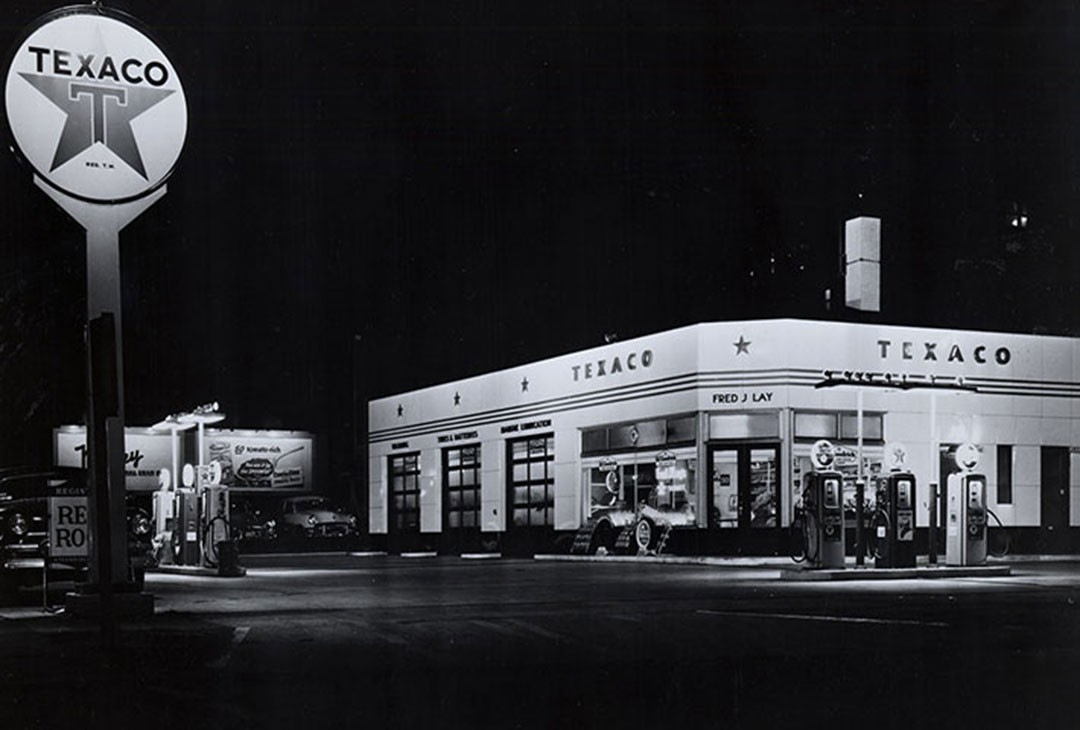
The office and the service areas (garage bays) were unified into one structure, an "oblong box", with large multi-pane windows and white, enamel porcelain-clad exterior walls, which became common. Parapets decorated with the corporate colors distinguished the service stations.
They were austere, modern, sported rounded corners, streamlined canopies, stripped down to the basic functionality required by service stations. Streamline Moderne architecture provided a feeling of modernity, movement, and progress.
The Teague Texaco Stations
Texaco had introduced the Golden Motor Oil lubricant in 1930, and in 1932, it launched its Texaco Fire Chief Gasoline, a high-octane upgrade of its previous line. The market was very competitive, and by 1934, the company decided that it needed to brand its 40,000 filling stations across the nation with a corporate identity, including signage, logos, and uniformly designed service stations.
It hired Walter Dorwin Teague, who came up with a standardized theme in five different variations named Types A through E. Each variation was adapted to a specific location requirement.
Teague pioneered a design that was quickly copied and adopted by Texaco's competitors. Texaco continued using it until the 1950s.

Features of the Teague Stations
- Oblong box design with a flat roof. Corner office on one end and the service bays on the other.
- The service bays were labeled with their purpose (Washing, Marfak Lubrication). The operator's name was written over the office door.
- White porcelain enamel panels on the outer walls. This gave a clean, bright, hospital-like look to the buildings. The panels didn't rust and were easy to clean.
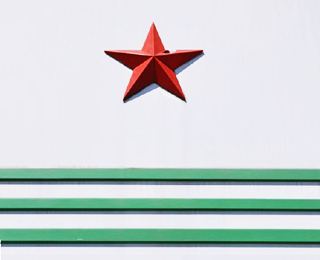
- Three green stripes ran along the upper part of the building's parapet, using Texaco's green color theme.
- Five-pointed red stars dotted the parapet, beneath the stipes.
- The sign on the curb, which was shaped like a banjo, had a white column that opened up to encircle the round logo with the red Texaco star with the green "T" and the word "TEXACO" written on it.
- Large metal windows on the office - showroom area.
- Large glazed, overhead doors for the service bays.
- On the upper part of the canopy, two parallel forms with rounded tips. These served as an area for the name "TEXACO", in red letters, and backlit, to be displayed.
- Thin, flat canopy with rounded tips, the three parallel, green stripes ran along its edge. Slender steel columns supported it.
- Restrooms. Entrance on the side, by the office.
- Rounded corners, Streamline Moderne design.
Teague obtained patents for his designs (see Pat. USD97539S, and Pat. USD107462S among others). Below is an image from one of these patented designs.

Variations in the Teague Service Stations
There were five different types of service stations depending on the location.
Type A: Oblong box with two service bays and a concrete island, no canopy.
Type B: Same as "A", could also have three service bays. The office had an angled corner. Designed for corner lots. Canopy.
Type C: Similar to "B", but the office corner was a conventional right-angle corner. Slightly wider. Canopy.
Type D: Oblong box, but the canopy was flush with the building. One or two service bays.
Type E: Rare. A small building consisting of only one room, with no service area. Canopies.

Some Teague Texaco Stations on Route 66
With over 45,000 stations by 1938, there were many Teague service stations across the nation and along U.S. Highway 66. Below is a short list of some of them, and links to some of them on our website.
- Canute, OK, Kupka Texaco
- Tulsa, OK, Red Fork Texaco
- Oklahoma City, OK
- Erick, OK
- Shamrock, TX, Western Texaco
- Amarillo, TX
- Amarillo, TX, Taylor's Texaco
- Tucumcari, NM, Guy's Texaco
- Albuquerque, NM
- Albuquerque, NM
- Albuquerque, NM, Ruffin Texaco
- Winslow, AZ, Smith Texaco
- Ash Fork, AZ. DeSoto
Oklahoma
California ¦ Arizona ¦ New Mexico ¦ Texas ¦ Oklahoma ¦ Kansas ¦ Missouri ¦ Illinois
Canute
Kupka's Service Station
At 105 Old US Highway 66, Canute, Oklahoma. This gas station used to sell Sinclair and Texaco gasoline. The locals know it as "Kupka's Service Station". Now it is abandoned.
It has a canopy over the service bay that blends into the roof of the office and garages. The style is the 1930s Art Moderne design, which streamlined buildings. It has some striking Texaco Teague design features (1940-40) with two parallel, rounded forms that project across the canopy from back to front (a rounded front was added to them, on the tip of the canopy). It also has three green bands around the building, canopy, and above the display and service bay doors.
Erick
Texaco Gas Station
At 615 Roger Miller Blvd. Nowadays, it is the only Texaco in Erick, there was another one other one, further west has been torn down ❌.
Though it has lost its canopy, you can make out its typical 1930s Teague design. It has two garage bays and one pump island. A projecting office with the three green Texaco stripes across the upper part of the building.

Click image for Street View
Old Red Fork (Tulsa) Texaco
On the western side of Tulsa, at 4207 Southwest Blvd, is an old Teague-styled Texaco service station, now a car dealership.
Its two ridge-like crests running across the canopy are still there.
Oklahoma City
OKC Texaco

Old Texaco Gas Station, Oklahoma City. Click for St. view
At 1601 NW 23rd St, Oklahoma City.
The old and now empty sign on the corner is shaped like a Phillips 66 logo, but the building is Texaco with the Teague design.
The design is simple, a minimalist box-shaped station with a flat canopy. The canopy still has the two ridge-like crests running across its top. Now it is "Magic Auto Repair".
Texas
Towns and Cities along Route 66 in Texas
California ¦ Arizona ¦ New Mexico ¦ Texas ¦ Oklahoma ¦ Kansas ¦ Missouri ¦ Illinois
Shamrock. Western Texaco

Western Shamrock Texaco
310 W 12th St., Shamrock. It catered to eastbound traffic along Route 66. It has a two-bay service area. See picture.
Amarillo, two Teague Texacos
The first is on the Beltway alignment of Route 66, at 7209 E Amarillo Blvd., there is an ancient oblong box-style station with two service bays, with multiple panes on the garage doors. Pictured below.
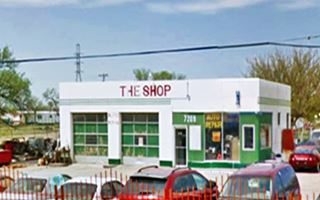
1950s Texaco station. Click for St. view

Taylor's Texaco Station. Click for St. view
The second station is shown in the image above, it was known as Taylor’s Texaco Station. It is located on the original Historic Sixth Street alignment. At 3512 West Sixth. The canopy preserves the original crests, which once sported the name TEXACO. Now it is a bar and restaurant.
New Mexico
Tucumcari, Guy's Texaco
At 1201 E Tucumcari Blvd. It has been neatly restored, repurposed as a jewelry, collectibles, and antiques shop painted with the word "Texaco". It has also added some vintage gas pumps on its islands.
Originally, this was was Guy's Texaco station, and later Card's Texaco.
The current appearance doesn't fit in with the brand's Teague style because the gabled roof was a later addition. As you can see in its 1962 picture below, it had the classic flat canopy topped by the brand name.

Guy's Texaco nowadays. Click for St. view

1962 photo Guy's Texaco. Source
Albuquerque: Three Teague Stations
Rubio's
At 7522 Central Ave SE, Albuquerque is Rubio's auto repair shop, which was at one time a Teague Texaco Station. It opened in 1948 and has four service bays that face Route 66. Pictured below.

The second station is located on the original 1926-37 Route 66 alignment through Albuquerque, at 6001 4th St. NW. Now it is Brown's Auto. The canopy still has the crests. It has two bays. Pictured below.

Brown's Texaco, ABQ. Click for St. view
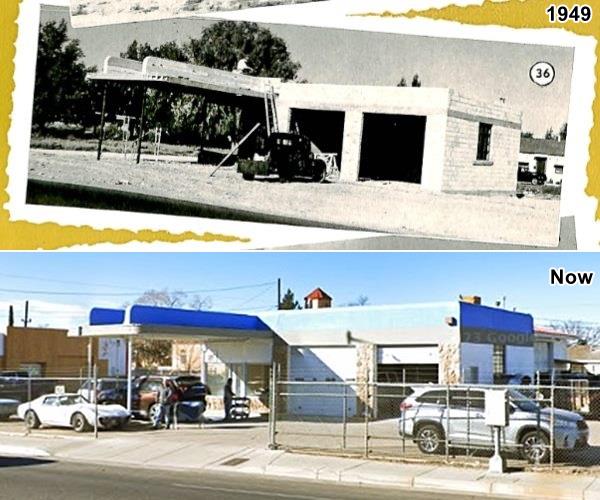
Ruffin's in 1949 and now. Source;
Click on image to enlarge
Ruffin's Texaco #1
Located at 4201 NW 4th St.
It's newer than Route 66 because it dates back to 1949, but we include it for those who like old gas stations. Notice the two crests that run along the top of the canopy with curved tips, part of Teague's Streamline Moderne style design for Texaco stations. Ted Formahls built it for its owners, L. E. Ruffin, Jr., and W. H.Roloff; they owned another station closer to downtown, also on 4th St. Below is a "Then and Now" set of images.
See this Street view of the building.
Arizona
California ¦ Arizona ¦ New Mexico ¦ Texas ¦ Oklahoma ¦ Kansas ¦ Missouri ¦ Illinois
Winslow
Smith's Texaco
The 1960 phone directory tells us that at 201 W 2nd was Smith's Texaco station, a typical 1930s-40s Teague design. This is a Type B. Similar to the Ash Fork, AZ "De Soto" station. This design included an oblong box station with an angled office on the corner and a single canopy. It was used on corner sites. This station has been neatly restored and is recovering its former grandeur. The two tall poles with the Texaco sign can be seen in the Arnold's Shell inset, and they are still standing.
Ash Fork
DeSoto's Salon (old Texaco)
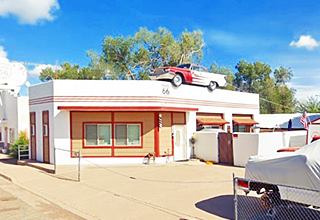
The old Texaco with the DeSoto on the roof. Click for St. view
At 314 W Lewis Ave., this old Texaco Station was modernized in 1957 and now sports a Chrysler DeSoto Adventurer 1960 model car on its roof, and it is driven by Elvis!
It was restored in 2001 and turned into a Beauty Parlor and Barber Shop (now closed). The service station had an angled corner office, similar to Texaco's Teague Type B stations.
The DeSoto on the rooftop:
Kingman
Downtown Texaco Gas Station
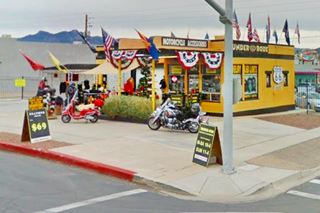
Old Texaco in Kingman. Click for St. view
102 E Beale St., on the SW corner of Beale and 1st Streets. Now, a motorcycle accessories shop that used to be a Texaco Gas station.
Notice its classic canopy with the transversal crests +ridges that were part of Texaco's brand identity.
The pumps' island, office, and two-bay garage are well preserved.
End of this Teague Texacos on Route 66 Itinerary
This marks the end of our journey along Route 66, visiting its surviving Teagye stations. Enjoy your Road Trip!

Sponsored Content
>> Book your Hotel in Kingman AZ


Credits
Banner image: Hackberry General Store, Hackberry, Arizona by Perla Eichenblat
Social Media


