

The Paranormal and U.S. 66
Index to this page

Bloody 66
Route 66 was a dangerous highway and was known as Bloody 66. It had heavy traffic, transcontinental buses, travelers, and commercial vehicles. It was congested in the main cities, and ran along the Main streets of all the towns it crossed. It had winding sections, sharp curves, hazardous bridges and underpasses, grade crossings, and narrow shoulders. The risks posed by the highway were made worse by the car technology of those days; they were not designed for safe collisions and lacked safety belts.
>> Learn more: Was Route 66 dangerous?
If ghosts exist, they will be found haunting the deadly segments along the highway like the Dead Man's Curve at the entrance to the dangerously narrow Beaver Creek Bridge near Doolittle IL (replaced in 2021), the "old bloody" stretch near Plano, MO, with two sharp curves at the two bridges that carried US 66 across the Pickerel and Sac River. Then there was the Death Trap" in Bushland, TX, and the famous Towanda Dead Man’s Curve in Illinois. There were many more!

Ghost towns
Many small villages have vanished, fading away into nothingness, ghost towns which some visitors say have an eerie feel to them. We can mention a few: Hext, OK, Endee, NM, Bagdad, CA.
State by State list of Haunted Sites
Below is a state-by-state list of spooky places, where ghosts have been reported along Route 66. Enjoy!
Illinois
California ¦ Arizona ¦ New Mexico ¦ Texas ¦ Oklahoma ¦ Kansas ¦ Missouri ¦ Illinois
The Inn at 835, Springfield
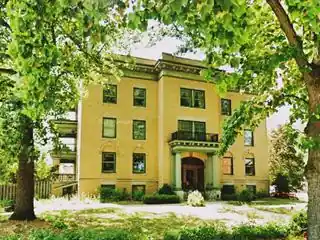
The Inn at 385, Springfield, IL
Located at 835 S. Second St., The Inn at 835, a boutique hotel, is known to be haunted by the benevolent ghost of Ms. Bell Miller. Bell was a local florist who became a successful businesswoman and built the hotel in 1909. She employed a local architect, George Helmle, who created the six-apartment building. It was restored in 1994. According to local lore, Bell stayed on her dream property after her death. The Inn is listed on the National Register of Historic Places and was designated a Springfield landmark by the City of Springfield. The hotel promotes itself as "Springfield's most haunted hotel" and in 2025 offered a Haunted Heritage Tour.
>> You can Book a Room in the Inn at 835 Boutique Hotel
Bigfoot haunting Funks Grove
In 2006, 58-year-old Tom Vielhak and his 31-year-old son, Chris sighted a bigfoot in Funks Grove, Illinois, (Source). They saw a hairy creature, 7 feet tall (2.1 m), standing beside a tree, it had a rancid smell, and after growling deeply, it fled into the woods.
Funks Grove is the largest remaining intact prairie grove in the state of Illinois and covers more than 1,000 acres of which 443 have been designated a National Natural Landmark. It is a forested island in the Grand Prairie of Illinois, a place where the trees managed to survive the prairie fires and gain a foothold against the grasses.
Missouri
California ¦ Arizona ¦ New Mexico ¦ Texas ¦ Oklahoma ¦ Kansas ¦ Missouri ¦ Illinois
Blue Moon Camp, Hazelgreen
In Hazelgreen Route 66 runs closet to Bear Creek, and on the north side of the freeway (map with approx. location) is a now abandoned cemetery where some of those who perished on the "Trail of Tears" march are buried.
The Indian Removal Act of 1830, signed by President Andrew Jackson, defined the fate of five Indian Nations: The Seminole, Creek, Choctaw, Cherokee, and Chickasaw. They were forced to relocate from their territories in the east to a new home in the "Indian Territory" (which later became Oklahoma), where they had been assigned reservations. The Act's goal was "remove" all Native Americans from the states east of the Mississippi River. This forced removal, exile, and relocation with little support or logistics caused the death of thousands of unfortunate Indians due to illness, exposure, fatigue, and starvation. The route these ill-fated people followed is now known as the "Trail of Tears", a name that hints at the hardship they had to endure on their death march.
Cemeteries are always considered the ultimate haunt; they combine fear, history, spirituality, and the grimness of death. In this case, maybe negative energy as it holds the remains of people who suffered greatly, unfair treatment that led to their death. Guardian spirits can be found there, where they are custodians and ward off intruders.
The Ghosts of Avilla, Missouri
In Avilla, MO, there is a local ghost, the "Avilla Phantom Bushwhacker", about a Confederate soldier known as Rotten Johyn Reb, who was a "Bushwhacker", who remained unburied. There was also a "Death Tree" where his skull was hung. The headless ghost is seeking revenge while he looks for his missing head.
Johnny Reb is the generic name for the Confederate soldier (The Union soldiers called them Reb, short for Rebel and Johnny) so the myth mixes many tales into one.
Kansas
California ¦ Arizona ¦ New Mexico ¦ Texas ¦ Oklahoma ¦ Kansas ¦ Missouri ¦ Illinois
Haunted Staffleback Bordello, Galena, KS

The "Haunted" Staffleback Bordello
Click image for St. view
This haunted spot is located in Galena, Kansas, at the crossroad where Front St. meets Main Street, both carry Route 66.
Set on the northeast corner of the intersection is a gable-roofed building that had fallen into disrepair and was recently restored. According to the local lore, in the 1890s, the place was a brothel run by the Staffleback family. In those days, Galena was a mining town, with many men seeking cheap pleasures.
The story says that some family members were convicted for the murder of one of their customers, and that the ghost of the deceased man still haunts the bordello.
Oklahoma
California ¦ Arizona ¦ New Mexico ¦ Texas ¦ Oklahoma ¦ Kansas ¦ Missouri ¦ Illinois
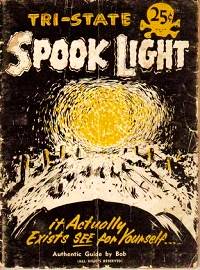
1955. Booklet by Ret. Capt. Bob Loftin on the "ghostly lights"
Source
The Mysterious "Spook Lights"
The "Spook Light" is a strange phenomenon that takes place east of Miami, Oklahoma, in the three-corner region of Kansas, Missouri, and Oklahoma.
This weird light spotted at night is described as a glowing ball of light with varying intensity that grows bright and dim. It also bounces about as if it were a ball tossed about in the air. It disappears and fades. It vanishes when people attempt to approach it.
The light can "dance through trees" or hop across fields. It is an old phenomenon, and the first written report was drafted in 1881. There were many sightings of balls of light near the village of Hornet in 1896.
The lights have been reported by people living in the area comprised by Quapaw, Commerce, Miami, Seneca, Hornet, Neosho and Joplin.
>> Read more about The Spook Lights
Riots, pogroms, and mass murder in Tulsa
Though not ghostly, or paranormal, these events reveal the perverse and ghoulish acts that humans can perpetrate. These murders and obscene acts violate the balance of nature and popular belief considers that they can leave a lasting paranormal imprint on the physical setting where they took place.
The African American community in the Tulsa Greenwood neighborhood was prosperous and peaceful, but the "Tulsa Race Riot" of May 31 and June 1, 1921, saw bloody racial violence with whites attacking blacks. The official toll was 39 dead (23 of them blacks), but the actual figure was closer to 300 dead (mostly black). 35 city blocks were burned and razed, and 10,000 people were left homeless.
A similar massacre had taken place in East St. Louis, IL, in 1917 when several thousand white men marched into the city and attacked African Americans in the streets. They burned buildings, mudered 100 to 200 blacks, left 6.000 of them homeless when the rioters burned rail cars on the tracks next to the place where many African American families lived. A shameful situation compounded by the inaction of the local police and the National Guard who were ordered not to shoot white rioters, therefore enticing them to continue.
Kellyville's Haunted Crybaby Bridge
A Crybaby Bridge is a name given to certain haunted bridges that get their name because a crying baby can be heard at the bridge. It is the ghost of the infant that died, or was killed there, or thrown off the bridge.
Located west of Kellyville, OK. it the haunted bridge across Polecat Creek. Map with directions.
This urban myth tells about a woman and her child who were driving down Slick Road, escaping from her husband, and she drove off the bridge into the stream below. The baby's body was never recovered. And its ghost remains there until this day, crying under the bridge.
Hydro's Ghostly Mounds

Dead Woman Mound, Hydro. Source
Roughly 9 miles south of Hydro, OK, there are several small hills on an otherwise relatively flat area. They are natural hillocks known as "Antelope Buttes", "Hydro Mounds", or "Caddo Mounds".
"Dead Woman Mound" (1,700 ft.) got its name after a pioneer found the body of a woman buried at its foot. "Ghost Mound" was an Indian ceremonial site. See its Satellite view.
In 1940, American author of horror and fantasy stories, H. P. Lovecraft (1890 - 1937), fittingly ghostwrote a story, "The Mound", for Zealia Bishop. It is set in Caddo County and tells the story of an Indian mound haunted by a headless ghost of a woman, it is a typical example of his obscure, tales, steeped in dread.
Texas
Towns and Cities along Route 66 in Texas
California ¦ Arizona ¦ New Mexico ¦ Texas ¦ Oklahoma ¦ Kansas ¦ Missouri ¦ Illinois
The Natatorium in Amarillo

Old photo, Nat Ballroom. Source
Half a block from Route 66's alignment along 6th Street in Amarillo, Texas, at 604 South Georgia is the Natatorium, also known as Nat Ballroom or simply "Nat". It was built in 1922 to house an indoor swimming pool, and it became a ballroom in 1926. It had a 10,000 sq. ft. polished maple floor, neon-lit seating area, and a revolving mirrored ball. The second floor had a dining area, dance floor, and small stage with balconies overlooking the main dance floor.
It has been labelled the ugliest building in Amarillo, with a medieval castle facade including corner turrets and battlements on its eastern face. The north face of the building was designed to resemble an ocean liner with lifeboats and all.
There were dances every night except Monday, and a "big" band would play there every month (Duke Ellington performed at Nat's). It closed in 1960 and reopened in the 1970s for private events.
The place is said to be haunted on the second floor, where cold spots can be felt. Sometimes, staff find the furniture has been moved around during the night, and a woman in a red-wine-stained white dress can be seen on the second floor, as well as a couple on the main dance floor.
New Mexico
Kimo Theater, Albuquerque
Located on Central Ave (Route 66) and 5th St. in downtown Albuquerque, NM. The theater is Listed in the National Register of Historic Places.
The building blends native Pueblo motifs and Art Deco style. It opened in 1927.
The local urban myth says that the theater is haunted by the ghost of a six-year-old boy, Bobby Darnell, who died there in tragic circumstances when a heater exploded in the lobby on August 2, 1951. There were 1,000 spectators at the theater, and Bobby had gone there with two friends. The blast injured seven people
Those who perform in the theater leave small gifts for Bobby, like toys, candy, etc., to ensure that their performances go smoothly and avoid ghostly pranks or glitches.
Kimo closed in 1968 and was almost demolished. Luckily, it was saved from the wrecking ball and restored in the 1990s.
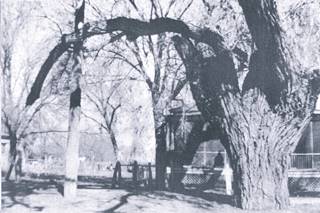
Hanging Tree with its "hanging limb". Source
Los Lunas: Site of the Hanging Tree
On the original 1926-1937 Route 66 alignment, at 460 Main St. NE, in Los Lunas, where the Los Lunas public library now stands, was the site of the local hanging tree, taken down in the 1960s.
It had a "hanging limb" that jutted out over the roadway. It was considered haunted by the locals, due to the spirits of the people who had been hung here as criminals, maybe some were innocent.
How Budville, NM earned its nickname of Bloodville

Larry E. Bunten. Source
Many violent events took place here, including the death of three people. It is a hotspot of negative energies.
Howard Neil "Bud" Rice (1913-1967) opened his garage on Route 66 south of Cubero, NM in 1936. He ran it with his wife, Aurora "Flossie" nee Chavez (1921-1994). They soon opened a Trading Company and named it "Budville", added a Phillips 66 gas station and a wrecker service, plus some cabins behind the building. The place became known as Budville.
Tragedy struck the evening of Friday, November 18, 1967, when both Bud Rice and his clerk, 82-year-old Blanche Brown, were killed. The murderer had stopped to fill up, and while Rice was pumping gas, he entered the store to buy cigarettes from Blanche. Somehow, they got into an argument as Bud entered the store. The man pulled a 9 mm gun, a struggle ensued, and five shots were fired, killing Bud and Blanche.
Bud's wife, Aurora, who was in the back of the store, appeared, and the man forced her to hand over the cash and jewelry, gagging her and tying her to a chair.
The cops set up roadblocks and captured a man. Flossie confirmed it was the right person. But, he wasn't.

Billy Ray White. Source
The police had arrested 23-year-old Larry E. Bunten, a Navy first-class petty officer. He was pulled over while traveling with his wife (an Acoma Indian) and their infant son. They had come to visit relatives. But ten days after his arrest, on Nov. 29, the FBI laboratory confirmed that Bunten's fingerprints didn't match those found at the crime scene. He was released.
The case went cold until three criminals disclosed information about 26-year-old Billy Ray White, who they said was the murderer. He had bought a "set-up" on the Trading Post from someone in Albuquerque and gone there to steal the tens of thousands of dollars that Bud supposedly had stashed away in his store. White made it to the FBI's 10 Most Wanted list, and he was spotted in Springfield, Illinois, on Aug. 17, 1968.
Flossie identified him as the criminal, and White stood trial but was acquitted. He was extradited to Louisiana, where he was facing charges for similar crimes committed in September 1967. He was found guilty and convicted to 10 years in prison. He died in jail on June 8, 1974, by apparent suicide, and one of his fellow inmates reported that he had confessed he was the Budville murderer.
Flossie then married a younger man, 33-year-old Max Atkinson. Max died after a brawl on June 7, 1973. His brother Phillip had been killed earlier, in front of Budville Trading post in 1971, and Max was wounded in the same attack. Flossie, twice a widow, remarried for a third time, to Obie Hall, becoming Mrs. Aurora Hall, and continued running the store on her own until she closed it in 1979. She passed away on April 10, 1994, and is buried at Budville Cemetery.
Was Billy Ray White the murderer? He had committed similar crimes in the past. Or did Flossie and Max plot to murder Bud?
Interestingly, racing legend Bobby Unser, whose father ran a tow business and also owned the Jerry Unser garage on Route 66 in Albuquerque wrote in his 2004 book the following comment:
Not all the people who had garages on Highway 66 were as upstanding and helpful as my daddy. Bud Rice had a place on Highway 66 about 60 miles west of Albuquerque in Budville, New Mexico. He'd do things to break the cars... He was a bad person who gave auto repair a bad name. Someone eventually shot him and killed him. He reaped what he sowed
The Route of the Beast, Cursed U.S. 666
>> See the interactive map of former U.S. 666 (marked with a black line).
US 666 was a spur of Route 66 in New Mexico, which, as we will see below, was renumbered as a spur of U.S. 191, and is now known as US 491
The number 666 has a powerful religious meaning for Christians because in the Bible, in Revelation 13:18, the number 666 is mentioned as the number of the beast: "This calls for wisdom: Let the one who has insight calculate the number of the beast, for it is the number of a man, and his number is 666."
The highway had a high rate of accidents and fatalities, and it earned the nickname of "Devil's Highway".
At the request of the New Mexico DOT, on May 31, 2003, the American Association of State Highway and Transportation Officials approved a new number for Route 666, and redesignated it as U.S. 491.
It was an unsafe highway, and most accidents were caused by people D.U.I. The state officials mentioned the highway's evil connotation in their request to have the number changed and gave the following reasons:
WHEREAS, people living near the road already live under the cloud of opprobrium created by having a road that many believe is cursed running near their homes and through their homeland; and
WHEREAS, the number "666" carries the stigma of being the mark of the beast, the mark of the devil, which was described in the book of Revelation in the Bible; and
WHEREAS, there are people who refuse to travel the road, not because of the issue of safety, but because of the fear that the devil controls events along United States Route 666; and
WHEREAS, the economy in the area is greatly depressed when compared with many parts of the United States, and the infamy brought by the inopportune naming of the road will only make development in the area more difficult....
Arizona
California ¦ Arizona ¦ New Mexico ¦ Texas ¦ Oklahoma ¦ Kansas ¦ Missouri ¦ Illinois
Haunted Toonerville, AZ
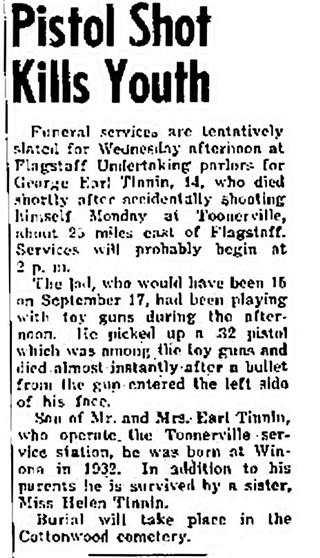
Obituary of George Earl Tinnin, son of Toonerville trading post owners. Read obituary
The Trading Post building is still standing, but now it is private property and a home. It was owned and operated by Elsie May Wells (1911-1999) and her husband Earl Lorenzo Tinnin (1904 - 1972).
Suicide
Death struck Toonerville in 1947, Elsie wrote that "most of our happiest days, also our saddest days were spent at our Toonerville home on Old Highway 66."
Her sadness was due to the tragic accidental death, in 1947, of her son George Earl, aged 14 due to self inflicted gun wounds.
Double Murder
Then, almost a quarter of a century later, murder struck Toonerville again.
It is known as the "cold case 1971 killing". On August 30, 1971, two African American couples hit the Trading Post, which at that time was run by "Slick" McAlister and his wife, Perl.
They robbed the place, murdered Merritt, and shot his wife in the head, but she survived. The killers were never caught. The 70's had their quota of violence.
Murder, Suicide
On Nov. 17, 2016, death hit Toonerville again. 55-year-old Mary Smeal was killed by her 57-year-old partner, Jreffery Jones, who then committed suicide. Both died from gunshot wounds. Mary was a member of the "Historic Route 66 Association of Arizona" and worked hard on the preservation project at Twin Arrows. She had rescued one of the arrow's feathers, hand-painting them to match the original colors.
Two Guns: Apache Death Caves
In 1922, a young World War I veteran named Earl Marion Cundiff bought a homestead here in Two Guns. In 1925, he leased it for ten years to a man named Harry E. "Indian" Miller. Miller claimed to have lived among the Philippine headhunters while serving in the Army during the Spanish-American War (1898). He called himself "Chief Crazy Thunder" and said he was part Apache and part Mohawk.
Miller moved there with his wife and built a trading post with a zoo, fake native stone ruins, and promoted the "Apache Death Caves".
Manslaughter or Murder?
Unfortunately, Cundiff and Miller did not get along well, and on March 3, 1926, Miller shot an unarmed Cundiff and killed him; he claimed it was in self-defense and was acquitted.
The store's interior burned in 1929, and that same year Earl's widow, Louise Cundiff, built her own tourist store nearby. Miller left the state to avoid further prosecution, and on Route 66, just beyond the Arizona state line in Manuelito, New Mexico, he repeated his show and built another zoo with fake ruins and a phony cave, the Cave of the Seven Devils. The seven devils are a typical reference to the seven deadly sins. Miller was savvy and knew what tourists wanted to see. He remained there until he died in 1952.
The Apache Death Caves - Massacre
In the 1960s, the site's brochure promoted their hourly tours as follows:
Apache Death Cave
- Scene of the merciless massacre of mighty Apache Warriors!
- Explore this mysterious underground world.
- Relive the revenge the crafty Navajo found upon his hated enemy
Two Guns brochure (1960s)
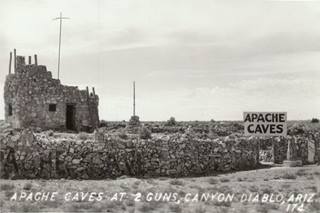
1930s Apache Death Caves. Source
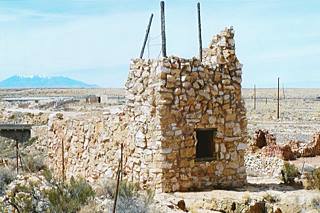
Current view, Apache Death Caves. Source
The cave is actually a series of natural caverns that extend for several miles under the sandstone.
The legend behind the caves is the following: In the late 1800s, Apache warriors would attack the Navajo people and disappear without a trace. After a bloody raid, the Navajo set out after their attackers and, by chance, discovered them hidden in these natural caves. After learning that the Apache had killed their Navajo hostages, the furious Navajo blocked the narrow entrance to the cave with wood and branches and lit a fire. The smoke killed 42 Apaches and disuaded them from further raids in the area.
Bucket of Blood Saloon, Holbrook, AZ
In Holbrook, Arizona, in the original commercial district, at 119 S. Central Ave. (see its St. view).
It is part of a site listed in the National Register of Historic Places, in bad shape. Saloons were a key element in the social life during the Old Wild West days. Ranch workers interacted, drank heavily, played cards, and womanized there. Alcohol and gun-toting men led to frequent shootings, too.
The place was originally named "Cottage Saloon", and was built in 1888 by Byron Terril, who sold it the following year to Charles O. Brown.
After a double murder that took place there in 1891, it became known, informally, as "Bucket of Blood". The county prohibition in 1913 and the statewide prohibition on December 31, 1914, killed the business.
Flagstaff, the Hotel Monte Vista
Located in downtown Flagstaff on the NE corner of Aspen and N. San Francisco St. Pictured below. It was built in 1926 with its great sign above its roof. The hotel's website has its fair share of ghost stories: like the Meat Man of Room 220, he was a long-term resident who hung raw meat from the chandelier. He was found three days after he died in this room, and haunts the place to this day. In room 305, some guests have seen a woman in a rocking chair. Two prostitutes who worked in the red-light district beyond the railway depot were murdered in room 306. Guests say they wake up in this room, unable to breathe. Then there is the phantom bellboy announcing room service and the baby crying in the basement.

California
Pasadena's Colorado Street Bridge: Suicide Bridge
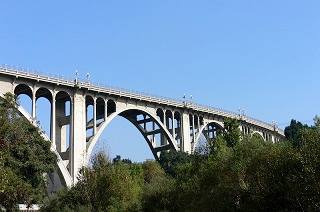
Colorado Street Bridge, Pasadena, CA. Source.
The bridge is listed in the National Register of Historic Places, and was erected in 1913 to replace the burdensome downhill and uphill route across the steep slopes of Arroyo Seco River gully in Pasadena, CA. The curved bridge allowed it to find adequate solid support in the weak soil of the river bed. Its concrete arches, rising 150 ft. above the riverbed, made it the highest concrete bridge of its time. It had two 5-foot-wide sidewalks flanking the 28-foot roadway.
It soon became famous as the "Suicide Bridge". The first person jumped off it in 1919. During the Great Depression, many committed suicide on the bridge, and the death toll is probably more than 100. Ten-foot-high fences line the bridge as a barrier to dissuade potential suicide attempts on the bridge.
This bridge carried Route 66 from 1926 to 1940, and later, it carried Alternate 66 until it was decertified in 1964.
Travel Tips for the Superstitious Traveler
A good trip requires some specific rituals to create good luck and ward off bad omens and evil.
Try starting your journey with the right foot. Never travel on Friday the 13th, or on a Friday in general.
Don't look back once you leave home. Don't return to pick up forgotten items. Wave goodby but don't watch them till they are out of sight. Never say goodbye on a bridge.
Carry a lucky charm. Avoid hotel rooms and airplane rows with the number 13. Respect holy or sacred sites (cemeteries, churches, native ceremonies, ruins).
During a road trip, keep the car clean and uncluttered, let the positive energy flow. Be smart: always keep your tank full, running out of gas is dangerous and unlucky. Hide your valuables and prevent bad things, like theft, from happening.
Closing Comment
Personally, I don't believe in the paranormal, ghosts, or supernatural occurrences. I believe that all such events can be explained by science, psychology, or logical, natural causes. The same applies to UFOs / UAPs. I am skeptical regarding paranormal claims, and without undeniable, scientific proof, I must classify all supernatural claims as fiction, hoaxes, or misinterpretations of natural phenomena.
Americans and the Paranormal
A 2025 Gallup poll found that 48% of adult Americans believe in spiritual or psychic healing. 39% believe in ghosts, and 24-29% believe in the other six supernatural phenomena like telepathy, communicating with the dead, astrology, witches, and reincarnation.
42% of U.S. adults do not believe in ghosts, and 19% are not sure.
Sponsored Content
>> Book your Hotel in Kingman AZ


Credits
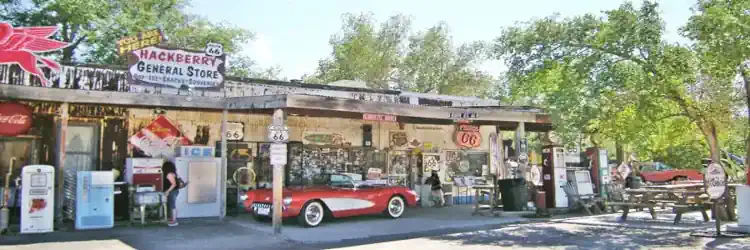
Banner image: Hackberry General Store, Hackberry, Arizona by Perla Eichenblat
Social Media


